

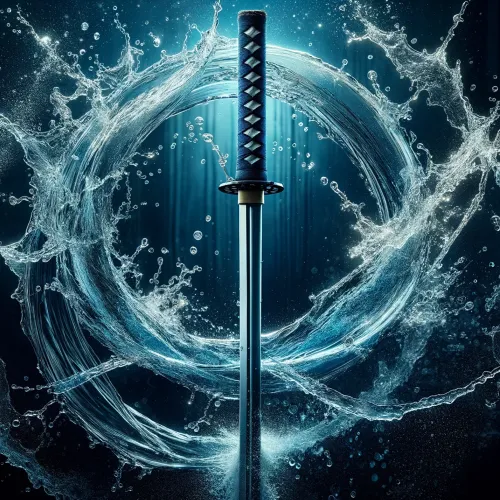
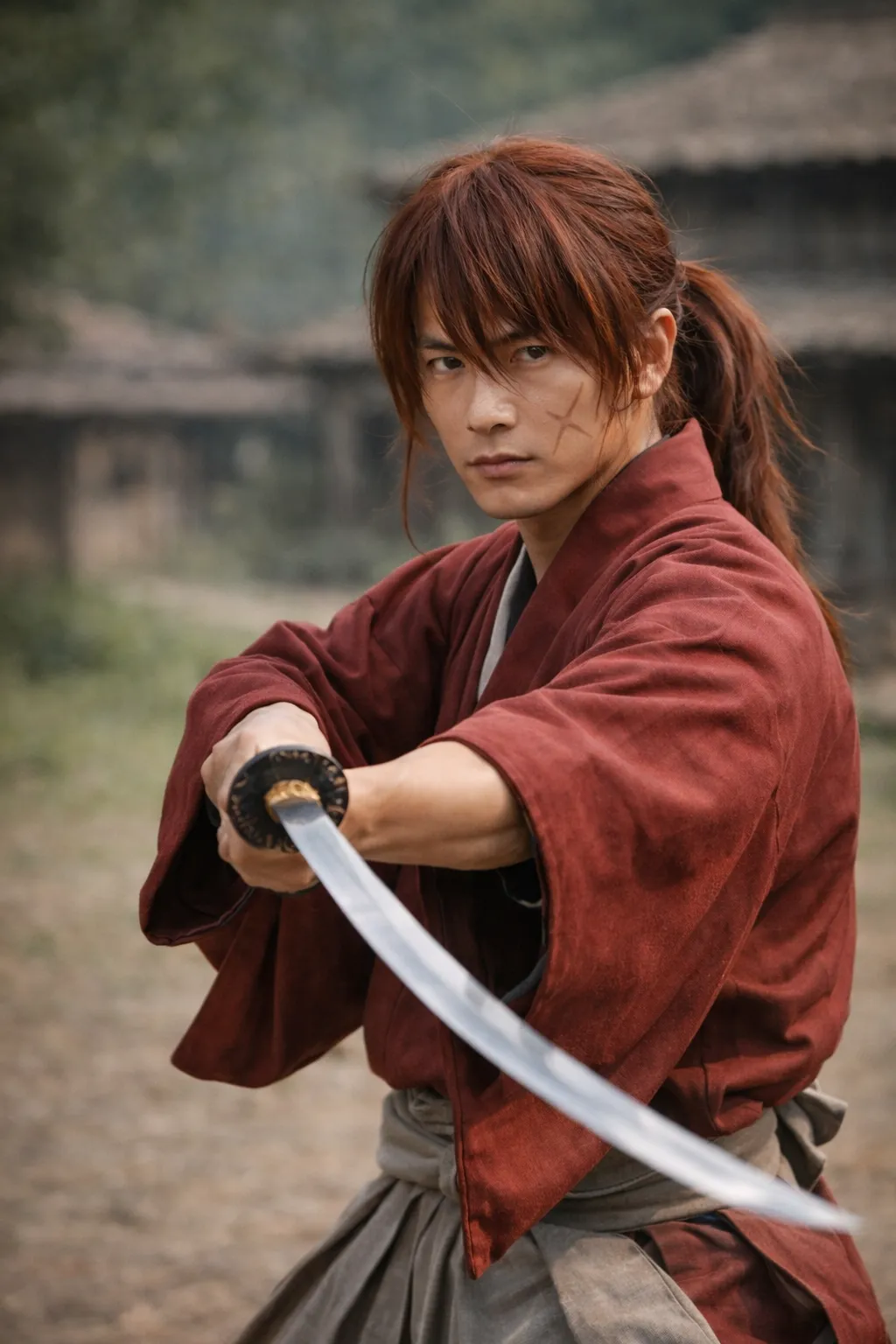
If you are a fan of Rurouni Kenshin (Samurai X), you know the iconic weapon of the protagonist, Himura Kenshin: the Sakabato, or “Reverse-Blade Katana.”
It looks like a standard Katana, but with a twist: the cutting edge is on the inner curve, and the outer curve is blunt. This design allows Kenshin to use his god-like skills to smash enemies without killing them, keeping his vow of pacifism.
But is this weapon purely anime fantasy? Or did Samurai actually use reverse-blade Katanas in history? The answer lies somewhere between “Myth” and “Forgotten History.”
- Fact or Fiction? As a primary battle weapon like Kenshin’s? Fiction.
- The Historical Exception: Small knives called “Kubikiri” (Head Cutters) existed with the edge on the inside, but they were tools, not fencing weapons.
- The Physics Problem: Traditional clay tempering (Yaki-ire) naturally curves the blade away from the edge. Making a Sakabato requires fighting the natural laws of Katana making.
- Modern Replicas: You can buy Sakabato replicas today, but they are modern creations inspired by the anime.
1. The Anime Myth: The Pacifist’s Katana
In the story, the Sakabato was created by a master swordsmith (Arai Shakku) for the wandering Samurai who vowed never to kill again.
The design philosophy is poetic:
“When you draw the Katana, the blunt side faces the enemy (mercy), and the sharp side faces yourself (penance).”
While this is a beautiful concept for a story, practically speaking, using the back of a normal Katana to strike an opponent (called Mine-uchi) was already a known technique for non-lethal subdual. The Sakabato simply makes this permanent.
2. Historical Reality: The “Kubikiri” (Head Cutter)
Did a “Reverse-Blade Katana” exist in history? No, and Yes.
No: It was not a battle weapon
There is no historical evidence of Samurai using a full-length Sakabato (like an Uchigatana or Tachi) for dueling or warfare. Using the inner curve to block or strike offers no mechanical advantage in standard Kenjutsu (fencing) and would likely compromise the structural integrity of the blade upon impact.
Yes: The “Kubikiri” (Short tool)
However, short blades with the edge on the inside did exist. These were called Kubikiri (literally “Head Cutter”) or Hanegatana.
| Feature | Standard Katana | Kubikiri (Historical) |
|---|---|---|
| Edge Location | Outer curve (Convex) | Inner curve (Concave) |
| Length | Long (over 60cm) | Short (Dagger/Tanto size) |
| Purpose | Combat / Dueling | Tool / Ritual / Trophy taking |
The Kubikiri was not used for fighting. It was likely used by attendants or servants on the battlefield to remove the heads of fallen enemies as trophies (a common practice in feudal Japan) or for crafting purposes. It functioned more like a sickle or a saw than a Katana.
3. The Forging Dilemma: Why Sakabato is Hard to Make
Why didn’t smiths make full-length Reverse-Blade Katanas? The answer lies in the physics of Yaki-ire (Clay Tempering).
How a Katana gets its curve (Sori):
- The smith coats the spine (Mune) in thick clay and the edge (Ha) in thin clay.
- When heated and quenched in water, the edge cools instantly and hardens (expanding slightly), while the spine cools slowly and contracts.
- This difference in cooling speed naturally pulls the steel into the iconic curve, pushing the edge outward.
The Sakabato Problem:
To make a Sakabato, the smith must put the edge on the inner curve. But the quenching process wants to push the edge out.
To create a functional Sakabato, the smith would have to forge the blade with an extreme, unnatural reverse curve before quenching, hoping the physics pulls it back into the correct shape. It is an incredibly difficult and counter-intuitive process for a traditional Katana smith.
4. The “Kawakami” Discovery (A Real Sakabato found?)
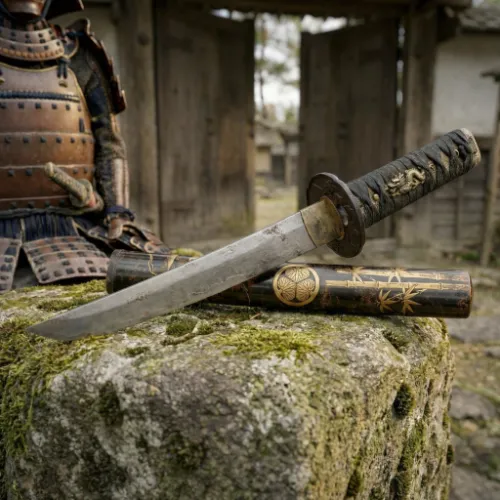
In 2013, a fascinating discovery made headlines in Japan. A small knife (Kogatana) was found in a storehouse in Shiroi City, Chiba Prefecture, which dated back to the Edo period. It was a Sakabato.
This tiny blade (approx. 11 inches) had the cutting edge on the inside and dragon engravings. However, experts concluded it was likely a “fantasy piece” or a special offering made by a smith to show off their skill, rather than a weapon for combat. It proves that the idea existed, but it reinforces that it was an oddity, not a standard Samurai Katana.
5. FAQ
Q1. Can I buy a Sakabato today?
A. Yes! Because of the anime’s popularity, many modern forges make replica Sakabato. You can find both blunt zinc-alloy versions for cosplay and sharp high-carbon steel versions for collectors.
Q2. Is a Sakabato practical for self-defense?
A. No. It is mechanically inferior to a standard Katana. Striking with the inner curve limits your range and changes the impact point, making it awkward to cut. It is a weapon designed for “mercy” in a story, not for efficiency in real life.
Q3. Did Kenshin use a specific style?
A. Kenshin uses Hiten Mitsurugi-ryu, a fictional style. However, the concept of “Battoujutsu” (drawing and striking in one motion) is very real. Doing this with a Sakabato, however, requires impossible wrist mechanics to cut effectively.
6. Summary
- The Sakabato (Reverse-Blade Katana) is primarily a fictional creation popularized by Rurouni Kenshin.
- Historically, only small utility knives or head-cutting tools (Kubikiri) had the edge on the inside.
- Making a Sakabato is difficult because it contradicts the natural physics of Japanese steel tempering.
- While it wasn’t a historical Samurai weapon, its design as a symbol of “protecting life” makes it one of the most beloved Katana variations in pop culture.
The Sakabato may not have been on the battlefields of 1868, but it holds a special place in the history of anime. Owning a replica is a great way to honor the “Samurai Spirit” of redemption and peace.

No comments yet.